MAGNET 2.0 to create integrated cold chain, processing, logistics and export infrastructure with private sector participation
Mumbai, (Maharashtra) [India] September 17, 2026: The Department of Agricultural Marketing and Protocol, Government of Maharashtra, will take up large-scale modern agribusiness infrastructure under MAGNET 2.0 as part of its plan to position Maharashtra as a leading State not only in agricultural production, but also in processing, value addition and exports.
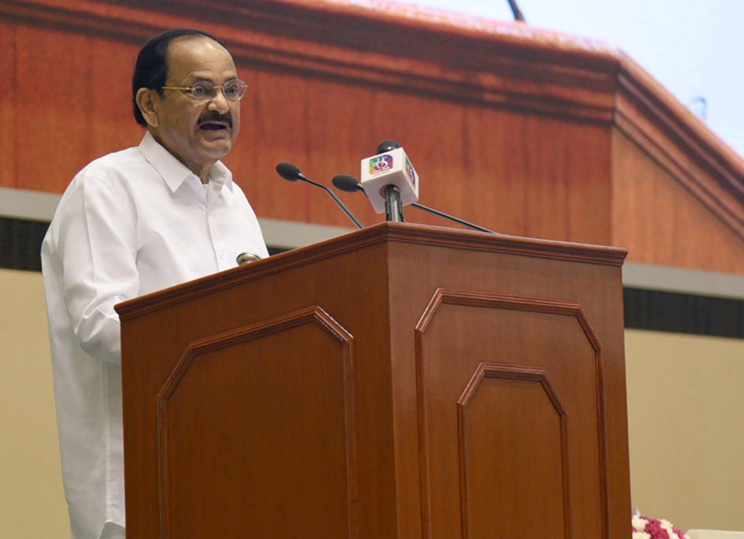
Addressing the MAGNET Agribusiness Infrastructure Investor Meet in Mumbai today, Minister for Agricultural Marketing and Protocol and Chairman of the Maharashtra State Agricultural Marketing Board Shri Jaykumar Rawal announced an investment opportunity of more than ₹1,000 crore across six agricultural clusters covering banana, pomegranate, mango, citrus, cashew and turmeric. He invited the private sector to participate as a partner in developing the infrastructure and businesses required across these value chains.
The proposed infrastructure across the six clusters is planned for an annual handling capacity of approximately 6 lakh metric tonnes and more than 1 lakh metric tonnes of cold storage capacity. It will include integrated agri-logistics hubs, aggregation and grading facilities, cold chain, processing and value addition facilities and export-oriented infrastructure. An Expression of Interest for the proposed clusters will be invited shortly. “Maharashtra has a strong agricultural production base. The next opportunity lies in what happens after the produce leaves the farm, how we aggregate it, grade it, store it, process it, transport it and connect it with consumers in India and across the world. This is where we see a significant opportunity for the private sector to invest, operate, innovate and scale,” Minister Shri Rawal said.
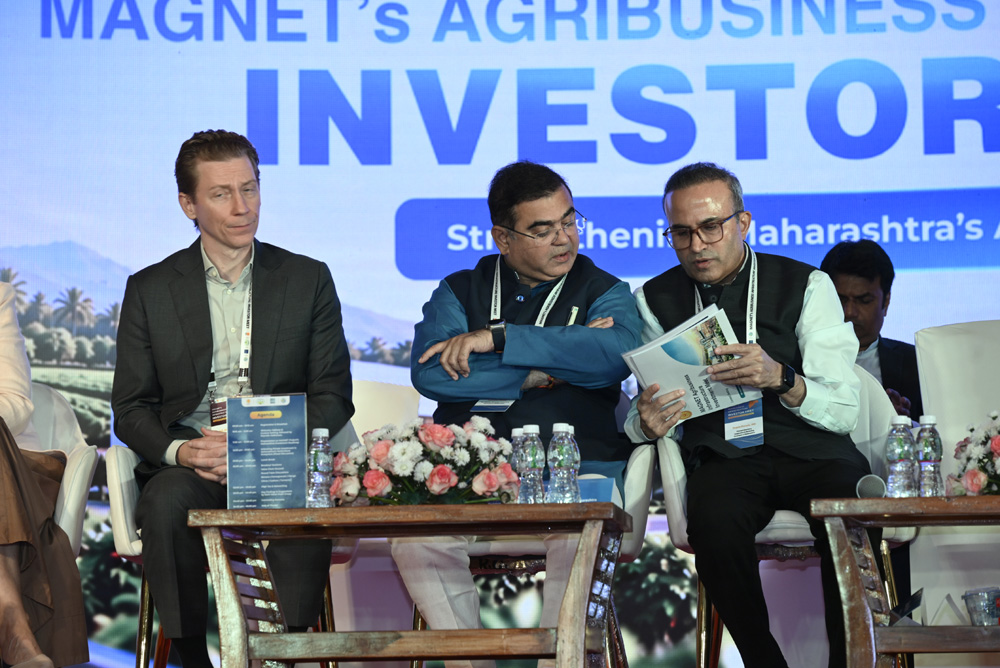
The Investor Meet brought together senior Government officials, representatives of the Asian Development Bank, international diplomatic representatives, investors, agribusiness companies, financial institutions, exporters, processors, retailers and logistics companies to discuss the investment and infrastructure requirements of Maharashtra’s agricultural value chains. Among those present were Shri Charansingh Thakur, Director, Maharashtra State Agricultural Marketing Board and Member of Legislative Assembly; Shri Praveen Pardeshi, Chief Economic Adviser to the Chief Minister and Chief Executive Officer, MITRA; Shri Pravin Darade, Principal Secretary, Agricultural Marketing Department; Dr. Rajesh Gawande, Secretary, Protocol, Foreign Direct Investment, Overseas Indian Affairs and Public Relations and Chief Protocol Officer; Shri Sanjay Kadam, Director of Agricultural Marketing and Executive Director, Maharashtra State Agricultural Marketing Board; Shri Vinayak Kokare, General Manager and Project Director, MAGNET; Takeshi Ueda, Asian Development Bank; and Krishan Rautela, Asian Development Bank.
Minister Shri Rawal said MAGNET 1.0 had demonstrated the economic impact that investment in post-harvest infrastructure, finance, technology and stronger value chains could deliver. More than 280 sub-projects have been supported, over 47,000 metric tonnes of cold storage capacity created and more than 33,000 farmers covered through capacity-building activities. Around 2.32 lakh farmers have been directly impacted, of whom approximately 43 per cent are women. Post-harvest losses in MAGNET crops have declined by around 8.73 per cent. The project has mobilised approximately ₹275 crore in private capital and generated around 4,300 direct jobs, with women accounting for around 48 per cent of these jobs.
MAGNET 2.0 will substantially increase the scale of the programme. With a total outlay of USD 250 million and support from the Asian Development Bank and the Government of Maharashtra, the second phase expands coverage from 15 value chains to 23. It is expected to reach more than 4 lakh farmers, strengthen and incubate 200 Farmer Producer Organisations and train 1.15 lakh members.
The second phase will focus on integrated infrastructure rather than individual assets. The proposed facilities will connect agricultural production centres with aggregation, grading, cold chain, processing, logistics, value addition and markets, addressing gaps that currently exist between different stages of the agricultural supply chain.
“This transformation cannot be achieved through Government investment alone. The Government will support infrastructure, finance, institutions and market systems, while the private sector brings capital, technology, processing expertise, operational capabilities, innovation and access to markets. We see the private sector as a partner in this transformation,” Minister Shri Rawal said. Dapchari proposed as international agriculture trade and logistics hub. Minister Shri Rawal also outlined the Government’s proposal to develop a world-class International Agricultural Market near Dahanu in Palghar district across approximately 1,300 acres. The proposed market at Dapchari is intended to connect Maharashtra’s agricultural production with national and international markets. Its location is expected to benefit from road, rail, sea and air connectivity, including Vadhavan Port, the proposed airport, the Dedicated Freight Corridor and the Mumbai-Delhi Expressway. “We should not look at Dapchari simply as another agricultural market. We are looking at it as an integrated food hub,” Minister Shri Rawal said.
The proposed facility is intended to bring international buyers, exporters, logistics providers, cold chain operators, processors, technology companies and FPOs onto a common platform. The objective is to connect infrastructure being developed at production centres with demand in domestic and overseas markets and allow agricultural produce to move more efficiently from farms to aggregation and processing centres and onwards to buyers. Minister Shri Rawal said MAGNET 2.0 and the proposed International Agricultural Market are closely linked with the Viksit Maharashtra 2047 vision. “We want Maharashtra to move from being a State that produces agricultural commodities to a State that creates, captures and exports agricultural value. We want our farmers to be connected not just to markets, but to higher-value markets,” he said.
MSAMB to focus on infrastructure and market connectivity
Shri Sanjay Kadam, Director of Agricultural Marketing and Executive Director, Maharashtra State Agricultural Marketing Board, said MSAMB will have an important role in taking the proposed infrastructure from production centres through aggregation, grading, storage and processing to logistics and markets. The Board will work on market intelligence, market linkages and export facilitation, along with stronger connections between Farmer Producer Organisations, value-chain operators, buyers and investment opportunities under MAGNET 2.0.
The programme also included an industry discussion with Shri Vilas Shinde, Chairman, Sahyadri Farms; Azhar Pathan of WayCool; Chirag Jain; Jinesh Shah of Omnivore; Salath Khan of Flipkart; exporter Kaushal Khakkar; and Krishan Rautela of the Asian Development Bank.
International representatives attending the programme included Jeff David, Consul General of Canada; Dhooshan Kumar Bucktowar, Consul General of Mauritius; Katerina Vovkova, Consul General of the Czech Republic; Dalia Tawfik, Consul General of Egypt; Walter Ferrara, Consul General of Italy; John Nickell, Head of Political and Bilateral Affairs at the British Deputy High Commission; Ezequiel Mariano Chabay, Deputy Consul General of Argentina; Karina Shihota from the Consulate of Canada; Hyewon Song, Consul of the Republic of Korea; Camille Dondenaz, Consul of France; and Farhana Ahmed Chowdhury.
Minister Shri Rawal said the State’s objective is to move from fragmented supply chains to integrated value chains, from primary commodities to processed, branded and traceable products, and from domestic markets to greater participation in global agricultural trade. “MAGNET 1.0 built the foundation. MAGNET 2.0 gives us the opportunity to build at scale, and the International Agricultural Market at Dapchari gives us the opportunity to connect that scale to national and global markets,” Minister Shri Rawal said.
Issued by
Department of Agricultural Marketing and Protocol
Government of Maharashtra