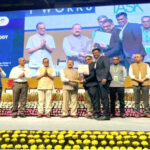


How a Dehradun upbringing and a modest Pune start became a handloom brand with two lakh returning customers — and why Akankssha Kanwaal’s next mission is far bigger than any single company.
Pune, Maharashtra: [India]: Fifteen years ago, Akankssha Kanwaal had an engineering degree, a small-town sensibility carried down from the hills of Dehradun, and roughly ₹5,000 to her name. She had no inherited capital, no metro networks, and no playbook for the world she wanted to enter. What she had instead was a stubborn belief that an idea raised in a small town could stand on a national stage — and one day, a global one.
Today, that belief has compounded into something rare in the bootstrapped Indian start-up landscape. The handloom brand she founded, Beatitude, has crossed ₹50 crore and built a base of more than two lakh returning customers — a loyalty number that most venture-funded labels spend crores chasing. And Kanwaal, now a Pune-based entrepreneur, growth coach and operator, has turned her attention to a question that has quietly shaped her entire career: how do you take the next thousand founders like her — from Dehradun, Nagpur, Cuttack, Indore — and put them on the world map?
The Dehradun Beginning
Kanwaal’s story does not start in a boardroom. It starts in a classroom in Dehradun, a city better known for its boarding schools and valley air than for its founders. She trained as an Electronics and Communication engineer — a degree that, on paper, pointed toward circuits and code rather than craft and commerce.
But the engineering mind turned out to be the unfair advantage. Where others saw textiles as tradition, she saw a system: supply chains to optimise, customers to understand, a digital storefront to architect at a time when most Indian handloom was still sold across a counter. In 2015, with that small starting capital, she founded Beatitude — a bootstrapped handloom label betting that India’s weavers deserved a brand as deliberate as any imported one.
“I didn’t start with capital. I started with conviction — and a refusal to believe that where you’re born decides how far your idea can travel.”
— Akankssha Kanwaal
Building Beatitude
The numbers came slowly, then all at once. Beatitude was never a flash sale or a discount-led growth story; the engine was product first, then storytelling, then a digital-first discipline that treated every customer as someone who should come back — not just convert once. That focus on retention, rather than the vanity of one-time acquisition, is what carried a ₹5,000 start past the ₹50-crore mark and built a community of more than two lakh customers who keep returning.
Along the way, Kanwaal became fluent in the unglamorous mechanics that actually scale a brand: inventory and cash flow, conversion and lifetime value, the difference between attention and trust. It is a fluency she now spends much of her time handing to others.
From Founder to Force-Multiplier
Having built one brand, Kanwaal has spent the last few years building the people who build brands. Today she works at the operational core of growth for India’s pharmaceutical distributors and manufacturers — applying the same retention-and-systems thinking that powered Beatitude to an entirely different, far larger industry.
That work has made her a sought-after marketing strategist for some of the country’s bigger pharma names, and a hands-on coach for direct-to-consumer founders trying to do what she did: turn a sharp idea into a durable, profitable brand. The through-line is consistent — she is less interested in noise than in the quiet machinery that makes growth repeatable.
“Talent isn’t concentrated in the metros. A founder in Dehradun or Indore has the same fire as one in Bangalore — what they’re missing is the digital bridge to the world. Meri zid hai to build that bridge.”
— Akankssha Kanwaal
The 2027 Vision
It is that bridge that now defines her mission. Kanwaal’s stated goal is to grow India’s MSMEs digitally — the small and medium businesses that employ the country but rarely command the attention or the tools of the funded few. Her ambition runs in two directions at once: to take small-town students and their start-up ideas to a global audience, and to carry India’s local specialities — its handlooms, its crafts, its regional makers — into international markets by 2027.
It is, in a sense, the same wager she made on herself fifteen years ago, now scaled to a generation. If a ₹5,000 start in Pune could become a ₹50-crore brand, the logic goes, then the only thing standing between a small-town founder and a global market is access, digital fluency, and someone who has walked the road first willing to light it.
For Kanwaal, the personal story was never the point — only the proof. The point is what comes next: a wave of MSMEs and young founders from India’s smaller cities, building globally from exactly where they are.
Radhe Radhe. — and onward to 2027.