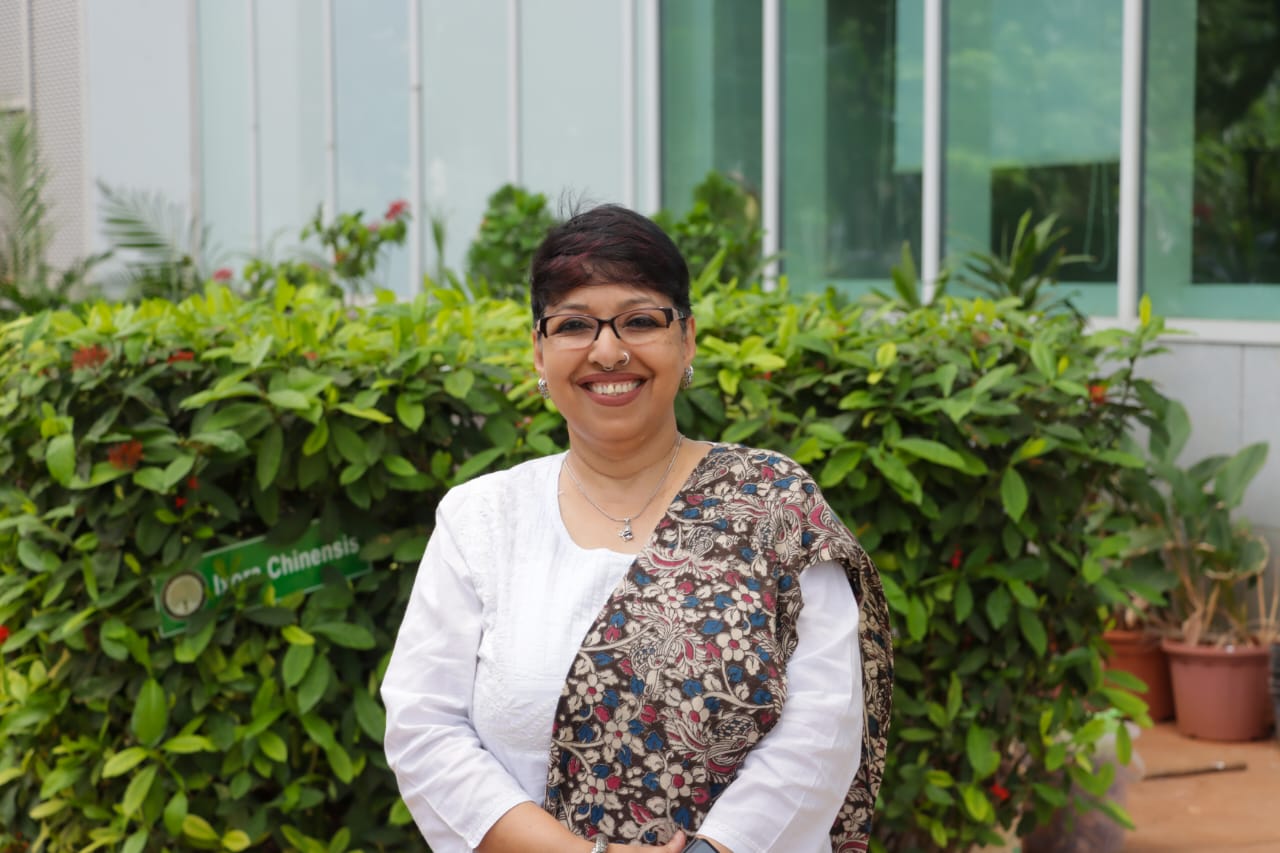
By- Dr Srabani Basu , Associate Professor, Dept. of Literature and Languages,
Easwari School of Liberal Arts, SRM University-AP
“Speak what we feel, not what we ought to say” _ Shakespeare
There is something quietly radical about the idea that reality does not begin with matter—but with meaning. That before form, there is formulation. Before structure, there is sound. The Upanishadic dictum Akshar Brahman– the imperishable reality expressed through akshar (word, syllable, vibration), places language not at the edge of human experience, but at its very origin.
What is striking is this: this idea is not uniquely Indian. Across civilizations, across faith traditions, across indigenous cosmologies, one insight recurs with uncanny consistency:
The world is spoken into being.
In the Upanishads, Akshar is not merely linguistic, it is ontological. It is that which does not perish. The syllable Om becomes the most refined expression of this truth: a primordial vibration from which all existence unfolds.
The claim is bold:
Sound is not describing reality. Sound is generating it.
This is not mystical exaggeration. It is a philosophical articulation of something we experience daily. Words do not simply report our world; they reorganize it.
In the Bible, the opening lines of the Gospel of John echo the Upanishadic intuition with remarkable clarity:
“In the beginning was the Word, and the Word was with God, and the Word was God.”
The Greek term used here is Logos. It does not merely mean “word” in the everyday sense. It refers to cosmic reason, order, and creative intelligence.
In the Book of Genesis, creation unfolds through speech:
“Let there be light, and there was light.”
Here, language is not descriptive, it is performative. It does not narrate creation; it enacts it.
Modern linguistics calls this a “speech act” which is a statement that does something rather than merely says something. The Biblical tradition places this power at the very foundation of existence.
In the Qur’an, creation is similarly articulated through the divine command:
“Kun fayakūn” (Be, and it is.)
This is perhaps one of the most concise expressions of linguistic creation in world philosophy. A single utterance collapses the distance between intention and manifestation.
Islamic theology also places immense emphasis on the recitation (tilawah) of the Qur’an. The sound of the words is not incidental. It is essential. The vibration, rhythm, and phonetic precision are considered carriers of meaning beyond semantics.
Here again, the insight is clear:
Word is not just meaning; it is force.
Long before written scriptures, indigenous cultures across the world preserved a similar understanding through oral traditions.Among many Native American traditions, the world is sustained through storytelling. Stories are not entertainment; they are cosmic maintenance.
Australian Aboriginal cultures speak of Songlines which are pathways across the land that are literally sung into existence. To sing the land is to keep it alive.
In African oral traditions, the spoken word carries ancestral authority. To speak is to invoke lineage, memory, and power.
Across these cultures, silence is not the absence of sound—it is the space from which meaningful sound emerges.
The pattern is unmistakable:To speak is to participate in creation.
Modern science, perhaps reluctantly, is beginning to validate what these traditions intuited.
In Cognitive Science,words shape perceptionLanguage directs attention. Attention filters reality. If you label an experience as “threat,” your brain activates fear circuits. Label it “challenge,” and entirely different neural pathways engage.
Neuroscience says words trigger biology. Words activate emotional and physiological responses. A single phrase can release cortisol or calm the nervous system. Language is chemistry in motion.
Linguisticsspeaks about the structure of thought. The Sapir-Whorf hypothesis suggests that language influences how we think. Without words, certain distinctions cannot even be perceived.
In essence, science now acknowledges that we do not see the world as it is. We see it as we describe it.At the level of the individual, words do something even more profound; they shape identity.
Consider the difference with these two sentences:
“I am broken.”
“I am going through a difficult phase.”
The first statement locks identity into a fixed state. The second opens movement, possibility, transition.
This is where ancient wisdom meets modern psychology and Neuro Linguistic Programming. The words you use repeatedly become the structure of your self-concept.And once identity is shaped, behavior follows.
If words create reality, then the task before us is not merely to speakbut to speak consciously.
You canreclaim the naming powerWhat you name, is what you frame.
“Problem” → “Situation”
“Failure” → “Feedback”
The event does not change. Your experience of it does.
Language often fuses identity with temporary experience. Break that fusion. For example:
“I am angry” → “I am experiencing anger”
This creates psychological space, and with it, choice.
The brain learns through repetition. The phrases you use daily become internal commands.
Choose them wisely:
“I am learning.”
“I am capable of finding solutions.”
These are not affirmations. They are instructions to your nervous system.
Every tradition; from the Upanishads to monastic Christianity to Sufi practice, recognizes silence as essential because words without awareness create noise.
Words with awareness create worlds.
If words shape reality, then language is not neutral, it is ethical.A teacher’s words can build or dismantle a student’s identity. A leader’s language can create fear or collective courage. A parent’s voice becomes the child’s inner dialogue.
To speak carelessly is to create carelessly.To speak consciously is to create responsibly.
Across the Upanishads, the Bible, the Qur’an, and indigenous traditions worldwide, a single thread runs:
Word is origin. Word is power. Word is creation.
What differs is the language.What remains constant is the insight.Every day,without ceremony, we engage in acts of creation.We describe ourselves.We interpret events.We narrate our lives.And in doing so, we are not merely speaking, we are shaping the architecture of our reality.
The Upanishadic seers called it Akshar Brahman.The Biblical tradition called it Logos.The Qur’an expresses it as “Beand it is.”
Different words. Same truth.Reality listens to language.
The only question is: What are you saying?